What is each property worth, and what does it leave me each month?
See what each property is worth and what it leaves you each month.
Each home and rental, with its value, debt, equity, monthly cash and what a sale would leave.
1. How do I add a property?
Add property, on Properties, is one page:
- The address, which finds the official suburb, and the property type.
- The contract date and the price you paid.
- Whether you've lived in it, rented it out, or both, with the rent where rented.
- Whether there's a loan on it.
- With no legal owner yet, your HELP debt, income and tax residency.
Saving opens Keep, rent or sell, or Add loan first when there's a loan on it. The value starts at the price and moves with the local market. A contract signed on 12 May 2026 asks its time too.
With more than one legal owner, it asks who owns it, starting as your other properties are held. The rest is on Edit property.
2. Which value is used?
Results use the newest value: the latest you recorded, or the PropRetire value The latest value entered moved with local market evidence for the same home type. where the market evidence is newer.
Record value takes a value and its date, and replaces one on the same date. After 12 months a value needs a newer figure.
Vacant land has no PropRetire value, and a house or unit needs an official suburb. Suburb research explains the evidence.
3. What does the Properties page show?
Property equity is the value less the All property loans What you still owe on the loans borrowed for the property. If you owe $400,000 on a loan taken out only for this home, all $400,000 is linked to it. , before selling costs and tax.
- Loan to value: the property loans over the value.
- Cash before tax: each property's month, added up.
- A loan that paid for two things counts only the part for the property. Loans explains.
Property records lists each property, largest first. Once one is sold, Show chooses current, sold or all.
4. What are cash before and after tax?
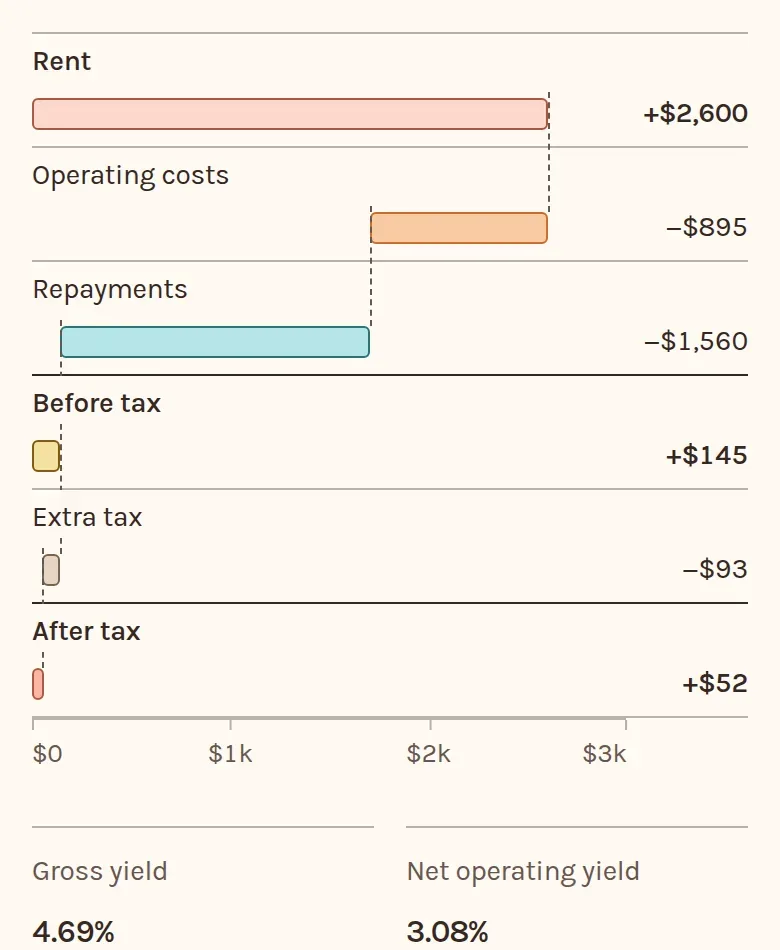
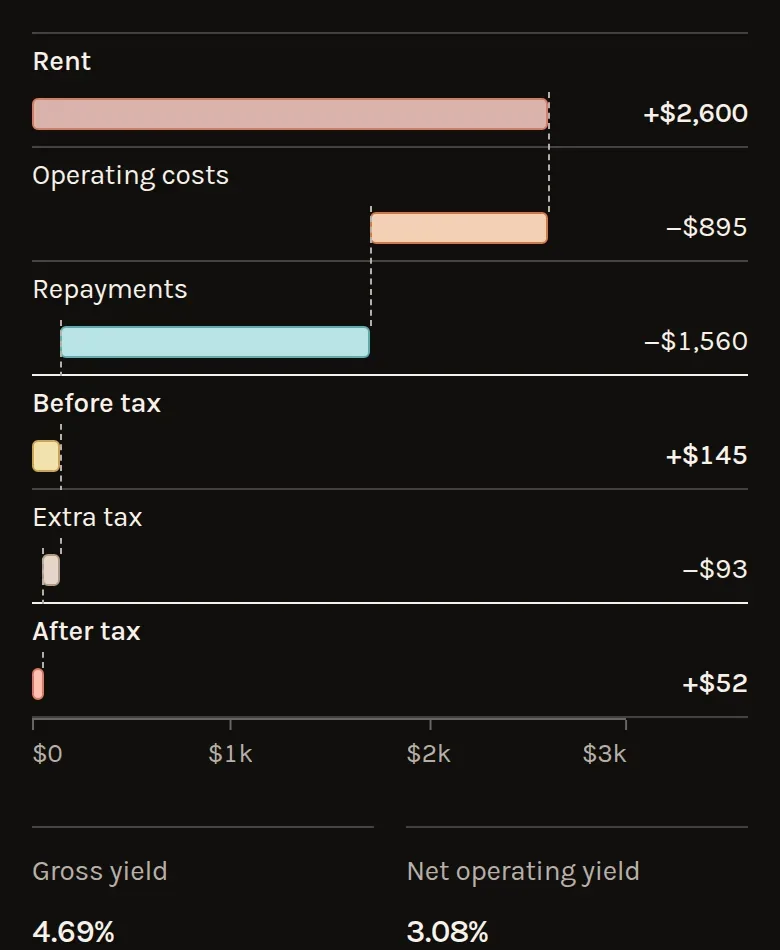
Cash before tax What the rent leaves in an average month after operating costs and loan repayments, before tax. Rent of $2,400 less $500 of costs and $2,300 of repayments leaves you $400 short, which you put in. is a year of rent less operating costs, interest and principal, divided by 12.
Cash after tax, on Cash each month, adds the tax and HELP its owners save or pay because of it.
Gross yield is a year's rent over the value. Net operating yield takes the costs off first. The tax a rental loss saves shows in Performance and Outlook.
5. What does a property's page show?
Four pages: Equity and value, Cash each month, Purchase and costs, and Outlook. Its sale is on Keep, rent or sell, in What if.
Purchase and costs holds the price, the dates, the buying and improvement costs and the depreciation. Each of the five pages has Download PDF and Send.
6. What does How you paid for it record?
How you paid for it, on Purchase and costs, records where the money for the purchase came from. It needs a settlement date on or before today.
Enter the price and buying costs, then any new loan and each bank payment. They must add up exactly.
A new loan counts only when it starts on the settlement date and all of it went to this property.
7. What does the outlook show?
Outlook projects the property to each 30 June: its value at its growth rate, its loans on their terms, and the cash it needs or returns. These are your assumptions, not a forecast.
Projection basis sets the years and growth, and Edit growth and vacancy the property's own growth. Equity is not cash you can spend: property equity is not future cashflow.
8. How is performance measured?
Performance, on Properties, gives what each property made or lost in a financial year: its value movement, rent less costs and interest, and allocated tax. Principal is left out.
Allocated tax is the change the properties make to their owners' tax and HELP.
9. How do I record a sale?
Record the sale, under More on the property's page, once settlement is done. Have the contract, the settlement statement, each owner's tax figures and the payout statement to hand.
- Sale details: contract and settlement dates, sale price and selling costs.
- Who owned it for tax: each owner's main residence treatment, cost base and any amount withheld for the ATO.
- Loan payouts the settlement paid directly.
- Where the cash went.
- Review and confirm.
The gain falls in the financial year of the contract date, and the property moves to Sold properties. The property records to gather lists what to keep.
10. How do I change or delete a property?
Edit property shows every part at once. Change what you need, then Save property.
When a cost changes, choose Record a new amount, then the figure and the day it starts. Past results don't move.
Nothing is saved before Save property. For the year's costs from your property manager's end of year statement, add it on Bring in and review what it gives.
A cost paid once takes Frequency Once and its day, and counts in that financial year. Capital works and Added to the cost base go into the cost base instead.
A capital works deduction comes only from the depreciation periods in Depreciation schedule. A new appliance goes in a depreciation period's Division 40.
Delete property, at the foot, deletes it and every record under it, so past results read as if it was never held. To keep its history, record the sale instead. While a loan pays for it, change that loan first.
A sold property can't be edited, and Correct the sale changes it.
11. What if a figure is missing?
It reads Unavailable, never zero.
- What to record lists each record a figure needs, with a link to its form.
- Until the operating costs are ticked complete, cash before and after tax and the yields are unavailable. A whole year's property manager statement ticks them for a new property.
- With Not sure for the main residence, the tax on a sale is unavailable. For a rental, Keep, rent or sell estimates it from what is recorded.
Setup lists what to add.